Process-powered Vacuum System
Process-powered Vacuum System
Solutions for handling organic gasses and vapors in fine chemical applications
About
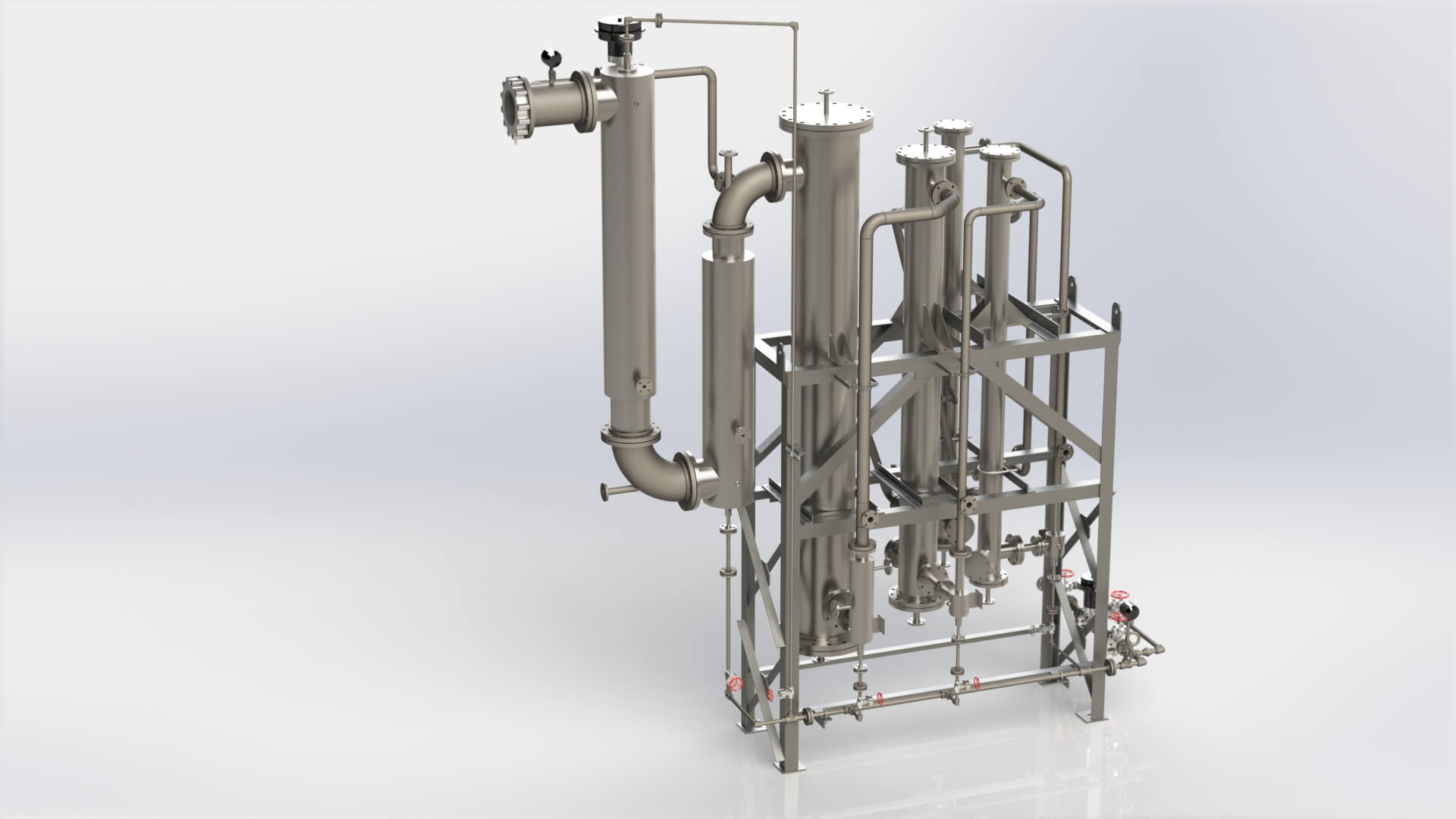
Process-powered vacuum systems offers a reliable and economical means of handling and compressing process vapor at different vacuum levels (high, medium, and low) while recovering valuable process components which can’t be contaminated with steam/water. A process-powered vacuum system is commonly driven by motive fluids such as mono-chlorobenzene, phenols, glycols, ethylene, and hexane. This type of vacuum system normally consists of ejectors, vaporizing systems, piping, condensers, pumps, instrumentation, and controls.
The most critical component of this type of vacuum system, like all other vacuum systems is ejectors. The most common type of heat exchanger used in process-powered vacuum systems is Surface condenser (also known as non-mixing or shell and tube) which avoids contamination of the products intended to be recovered. Like single and multi-stage steam ejector system the number of stages in each design can vary from one to six and is mostly determined by the level of vacuum for ejectors and the maximum coolant’s operating temperature for condensers. Most process-powered systems can be designed as Ejector or Hybrid Ejector (which utilizes Liquid Ring Vacuum pumps as last stage of the vacuum package).
Advantages
- Reliable, consistent service and output
- Reduces energy consumption and overall cost of plant operations
- Handles high volumes of gases and vapors at low, medium, and high pressures
- Captures condensable valuable products without contamination
- No moving parts
- Low initial cost (compared to mechanical pumps)
- Minimal maintenance cost (compared to mechanical pumps)
- Easy to install and maintain
- Easy to retrofit or upgrade
- Can be constructed from a wide variety of steel, alloy, and composite materials including thermoplastics such as PP, PTFE, and PVDF.
How it works
Ejectors converging-diverging nozzle technology convert the potential energy in high pressure motive fluid, in this case, mono-chlorobenzene, phenols, glycols, ethylene, and hexane, to velocity (kinetic energy) for entraining and compressing lower pressure fluid. These energy transfers operate according to the jet vacuum principle, which correlates the inverse relationship of potential-kinetic energies in supersonic, sonic, and subsonic zones. It can explain as the speed of a moving fluid (liquid or gas) increases, the pressure within the fluid decreases.
When the pressure energy (aka potential energy) of high-pressure motive fluid is converted through a converging-diverging nozzle, the result is high-velocity fluid exiting the motive nozzle at supersonic velocity. The force of this high velocity motive displaces suction fluid by creating a low-pressure region —a localized vacuum in the suction chamber—that entrains a suction fluid (i.e., process vapors) through an inlet nozzle connected to suction chamber. The high velocity motive fluid and low-pressure suction vapors mix freely as they flow through the diffuser, where the mixture experiences a shockwave and transitions back to subsonic zone by temporarily reducing the stream’s momentum; this change in velocity, creates another, subsequent increase in pressure.
The precise dimensions and arrangement of ejector components and internal geometry are expertly engineered to govern velocity/pressure conversions. The diffuser’s geometry moderates the outflow conditions of the mixed stream to discharge pressure required by the ejector stage. The diffuser’s output is then available to be cooled, condensed, and pumped through a condenser, compressing the fluids using motive energy or mechanical pump (LRVP with full recirculation arrangement) to the final discharge pressure required at the final stage of the vacuum system.
Use cases
-
What is a process-powered vacuum system?
A process-powered vacuum system uses a process compatible fluid, rather than steam, as the motive medium to generate vacuum and compress process vapors. Common motive fluids include mono chlorobenzene, phenols, glycols, ethylene, and hexane. This design is chosen whenever recovered products cannot tolerate steam or water contamination.
-
Why use a process fluid instead of steam to generate vacuum?
Using a motive fluid instead of steam keeps water out of the vapor stream, protecting the purity of valuable organic compounds. This matters most in applications where recovered material must be reused or reprocessed without further purification steps.
-
How does a process-powered ejector generate vacuum?
High pressure motive fluid passes through a converging diverging nozzle, converting pressure into a high velocity jet. That jet entrains process vapors and pulls them into a low pressure suction chamber. The mixed stream then moves through a diffuser, where velocity converts back into pressure for discharge.
-
What types of motive fluids can be used in a process-powered vacuum system?
Motive fluid selection depends on process chemistry, vapor pressure, temperature, and recovery requirements. Mono chlorobenzene, phenols, glycols, ethylene, and hexane are commonly used across different chemical processes. The right fluid keeps the system compatible with the vapors being handled while meeting performance targets.
-
How does a process-powered vacuum system help recover valuable products?
The system condenses and captures process vapors without direct contact with steam or cooling water, preserving product quality. A surface condenser is typically used to keep the recovered material separate from the cooling medium so it can be reused or processed further.
-
Why are surface condensers commonly used in process-powered vacuum systems?
A surface condenser, also called a non-mixing or shell and tube condenser, physically separates process vapor from the cooling fluid. This prevents cross contamination of the recovered product, which is essential in fine chemical and other purity sensitive operations.
-
What is the difference between an ejector and a hybrid process-powered vacuum system?
An all ejector system uses ejectors throughout the vacuum package, while a hybrid ejector vacuum system pairs process powered ejectors with a liquid ring vacuum pump, usually at the final stage. Hybrid configurations are chosen when a process needs both ejector performance and mechanical pumping capacity.
-
How many stages can a process-powered vacuum system have?
A multi stage ejector system can range from one to six stages depending on the application. The number of stages needed depends on the target vacuum level, compression requirements, vapor load, and condenser operating conditions.
-
What industries use process-powered vacuum systems?
Process powered vacuum systems are common in fine chemical processing, including distillation, drying, flash cooling, and fiber manufacturing steps such as polymerization. Any operation where organic vapor recovery and product purity matter is a strong fit for this technology.
-
What should be considered when designing a process-powered vacuum system?
Effective vacuum system design accounts for required vacuum level, vapor composition and flow, motive fluid properties, operating temperatures and pressures, condensation needs, coolant conditions, and materials of construction. Deciding between an all ejector or hybrid ejector and LRVP configuration is also a key part of the design process.